
For over two decades, the Quick Response (QR) code has served as the default bridge between the physical world and digital experiences. However, static 2D matrix codes are fundamentally limited: they require physical printing, display rigid links or fixed identifiers, and possess zero awareness of visual context or temporal dynamics. When embedded in video content, QR codes feel intrusive, static, and structurally disconnected from the visual narrative on screen.
For demo and meetings at Web Summit 2026: Booth A7-79 at ALPHA 7 in Pavilion 4.
The convergence of multimodal Video Large Language Models (Video LLMs) and the Model Context Protocol (MCP) introduces a decisive evolutionary leap. EGLA AI delivers an intelligent Video Scanner interface designed to replace static QR codes entirely, just a Web App, 100% HTML and Javascript.
By deploying real-time spatial vision and temporal video indexing, EGLA-SCAN transforms any digital display or broadcast video stream into an active, contextual interface. Instead of decoding a fixed block of black-and-white pixels, users point their device at a screen to identify visual scenes, surface dynamic real-time metadata, sync to exact video timestamps, and execute hyper-local actions.

1. Beyond the Barcode: The Architectural Evolution of Visual Scanning
Static barcodes and QR codes operate as passive lookup tables—mapping a visual pattern to a single fixed destination. They offer no spatial intelligence, no awareness of time, and no capacity to interpret visual environment dynamically. If a restaurant updates its menu, a retail store changes a promotion, or a broadcast stream shifts timestamps, a static QR code cannot adapt without backend remapping or physical replacement.
EGLA AI dismantles this friction by fusing Video LLMs with continuous scene recognition. Rather than scanning an artificial square pattern superimposed on a video frame, EGLA-SCAN analyzes the underlying video stream directly.
The comparative breakdown below highlights the key architectural differences between legacy 2D matrix codes and AI-driven video scanning:

2. Real-World Case Study: Deconstructing EGLA-SCAN at Brickell City Center
To evaluate the operational mechanics of the EGLA AI Video Scanner, real-time scanning demonstrations were conducted on walking tour video footage of Brickell City Center in Miami, Florida. The underlying video broadcast—titled “Brickell City Center – Miami Rooftop Views – Walking around BCC and surrounding areas.” published on YouTube by TravelwithEdTV—serves as the reference video stream.
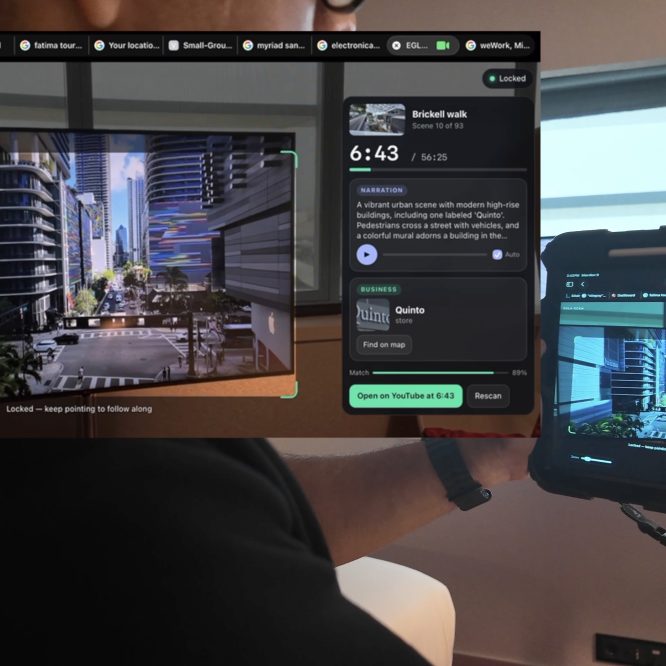
When a user points a tablet running EGLA-SCAN at a monitor playing this footage, the system locks onto the visual feed, matches the temporal sequence, generates descriptive scene narrations, and extracts actionable business intelligence in real time.
System State Confirmation: Throughout active scanning, the EGLA-SCAN interface maintains a continuous spatial lock, displaying the operational overlay: “Locked — keep pointing to follow along.”

Scene Breakdown A: Urban Architecture & Business Detection (Scene 10 of 93)
During the scanning of Scene 10 of 93 (timestamp 6:43 of a 56:25 walking tour video), EGLA-SCAN demonstrates high-precision visual indexing and cross-platform video syncing:
- Visual Scene Indexing & Match Verification: The scanner isolates the street-level corridor of Brickell City Center, recognizing modern high-rise architecture, pedestrian crosswalks, and prominent building structures. EGLA-SCAN displays a verified visual match confidence score of 89%.
- Automated Multimodal Narration: The integrated AI engine synthesizes real-time text and audio narration describing the visual scene:
“A vibrant urban scene with modern high-rise buildings, including one labeled ‘Quinto’. Pedestrians cross a street with vehicles, and a colorful mural adorns a building in the…”
- Contextual Entity Extraction: The system automatically identifies business entities within the frame—specifically pinpointing the restaurant store listing for Quinto.
- Interactive Action Triggers: Users can execute immediate context-aware actions:Find on Map: Launches spatial navigation mapping to the physical Quinto establishment inside Brickell City Center.Open on YouTube at 6:43: Deep-links directly to the exact timestamp (6:43) of the original YouTube video broadcast, enabling seamless source verification and playback continuation.Rescan: Re-analyzes the frame instantly if the camera perspective shifts.
Scene Breakdown B: Retail & Dining Discovery at Brickell Town Center Mall (Scene 9 of 93)
In a second demonstration focusing on Scene 9 of 93 (timestamp 5:06 of 56:25), the scanner processes an outdoor dining concourse within Brickell City Center Mall:
- Dining Concourse Parsing: The camera locks onto the entrance of MARABU, capturing its distinctive wood-and-metal entrance, overhead string lights, and seating layout.
- Automated Culinary Narration: The AI engine generates detailed contextual description:
“A vibrant outdoor dining area for Marabu, a Cuban restaurant with coal-fired cuisine, featuring string lights, wooden tables, and a welcome sign.”
- Multi-Entity Retail Detection: The EGLA-SCAN commercial panel simultaneously detects multiple adjacent venues in the concourse:MARABU: Listed with direct access to a “Find on map” spatial navigation trigger. MOTEK: Identified as a Cafe/Restaurant establishment within the same complex, equipped with immediate map routing capabilities.

3. Strategic Industry Implications: How Video LLMs Redefine Digital Commerce
The transition from static barcodes to AI-driven video scanning unlocks key strategic capabilities for retailers, digital marketers, and media platforms:
A. Dynamic Hourly and Daily Contextual Payloads
Unlike QR codes that point to a static web address, EGLA AI dynamically alters the information served to the user based on real-time factors. A user scanning a restaurant video scene in the morning can receive breakfast specials or coffee coupons, while the same video frame scanned in the evening automatically displays dinner menus, cocktail lists, or table reservation links.
B. Precision Timestamp Jump and Source Video Retrieval
Video content across television broadcasts, YouTube streams, or digital signage often features locations, products, or venues that viewers want to explore further. EGLA AI allows users to scan any screen, identify the precise scene (such as Scene 9 at 5:06 or Scene 10 at 6:43), and immediately open or retrieve the exact source video on YouTube at that exact timestamp.
C. Frictionless Geospatial Navigation and Local Action
By pairing visual entity recognition (such as Quinto, Marabu, or Motek) with direct action triggers (“Find on map”), EGLA-SCAN closes the gap between watching content and visiting physical locations. Viewers eliminate manual search friction, transitioning instantly from visual discovery to navigation, coupons, and store interaction.
4. Implementation Workflow for Enterprise Media and Retail
Deploying EGLA AI video scanning across broadcast, digital signage, and mobile environments follows a four-stage process:
- Visual Stream Ingestion: Live camera feed captures the target display or broadcast video.
- Temporal Scene Alignment: Video LLMs and MCP evaluate visual features, matching scene signatures against video repositories (achieving match scores such as 89%).
- Contextual Entity Resolution: Multimodal AI generates natural language scene descriptions and indexes commercial venues.
- Action Layer Execution: Interactive controls populate the user’s screen—enabling map routing, YouTube timestamp jumping, contextual menu pop-ups, and targeted promotions.
Conclusion: Entering the Era of Spatial Video Intelligence
The QR code served its purpose during the early mobile web, but modern interactive experiences require real-time visual intelligence. By combining Video LLMs with the Model Context Protocol, EGLA AI converts any video feed into a smart, interactive digital portal. From Miami’s Brickell City Center to global broadcast media, video scanning makes every frame actionable, context-aware, and connected.
The future of digital engagement isn’t a printed matrix box—it is built directly into the visual world we watch every day.
Covered under US Patent: 12,346,399 (US), Pending (EU, China, Korea, Canada, India)


